How the MV-DA2XO Connects Dante Networks to XLR Audio Systems
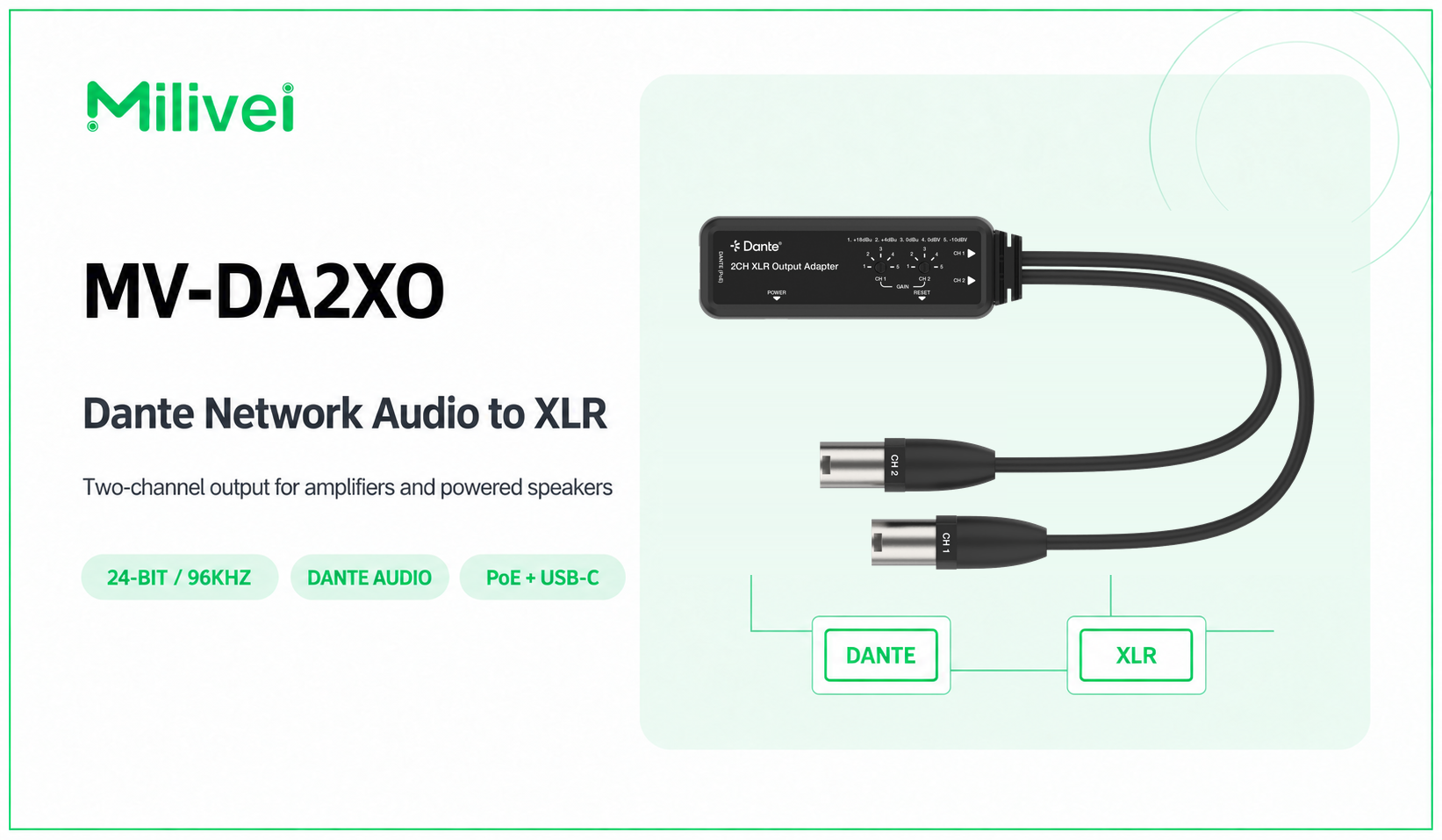
A practical look at how the MV-DA2XO converts two channels of Dante network audio into XLR analog outputs, with selectable gain, flexible power options, configurable latency and AES67 support.
Networked Audio Still Needs Analog Connections
Dante makes it possible to move multiple audio channels across a standard IP network, but many devices at the edge of an AV system still rely on analog connections. Power amplifiers, powered speakers, recording equipment and legacy audio processors may offer XLR inputs rather than a native Dante interface.
The MV-DA2XO provides a direct bridge between these two parts of the system. It receives two channels of digital audio from a Dante network and converts them into two-channel XLR analog audio. This allows existing analog equipment to become an output endpoint within a Dante installation without replacing the downstream device.
The Signal Direction Is Dante to XLR
Understanding the signal direction is important when selecting a Dante adapter. The MV-DA2XO is an output adapter: audio enters through the Dante network connection and leaves through the two XLR connectors. It is designed for sending network audio to analog equipment, not for placing microphone or line-level XLR signals onto the Dante network.
For the reverse direction, an XLR-to-Dante input adapter is required. Keeping the input and output models clearly separated helps system designers avoid a common specification mistake and ensures that every adapter is installed at the correct end of the signal path.
How to Send Computer Audio to the MV-DA2XO
Connecting a computer to the MV-DA2XO with an Ethernet cable is not enough by itself. A standard computer network port carries data, but it does not automatically convert music, video or application audio into Dante audio. The computer needs Dante Virtual Soundcard so that its audio can be transmitted over the Dante network.
The recommended connection is: computer with Dante Virtual Soundcard to a Dante-compatible network or PoE switch, then to the MV-DA2XO, followed by XLR cables to an amplifier, powered speakers or another analog audio device. If a PoE switch is used, the same Ethernet cable can carry Dante audio and power the MV-DA2XO.
Dante Controller is then used to route the computer’s audio channels to the two output channels of the MV-DA2XO. Dante Virtual Soundcard makes the computer a Dante audio source, while Dante Controller assigns that source to the required destination.
A direct Ethernet connection between the computer and adapter may also be possible in a simple setup, but the MV-DA2XO must be powered locally through USB-C and both devices must use compatible network settings.
Professional Audio Quality with Configurable Latency
The MV-DA2XO supports Dante audio at 24-bit resolution with 44.1, 48, 88.2 and 96kHz sample rates. This range allows the adapter to work with common professional audio formats used in conference, education, installed-sound and production environments.
Network latency can be configured to 1, 2 or 5ms through Dante Controller. A shorter setting may suit a small, well-managed network, while a larger value provides more tolerance when the network topology or traffic requires it. The appropriate setting should be selected according to the actual Dante network rather than treated as a fixed product value.
Five Output Gain Settings for Downstream Equipment
Different amplifiers and analog audio devices expect different input levels. The MV-DA2XO provides five output gain settings: +18dBu, +4dBu, 0dBu, 0dBV and -10dBV. This allows the output level to be matched more appropriately to professional and consumer-level equipment.
Correct gain selection helps maintain usable headroom and avoids sending an unnecessarily high or low level to the receiving device. During commissioning, the installer can choose the setting that best matches the connected amplifier, speaker, mixer or recording input.
PoE or USB-C Power for Flexible Placement
The adapter supports IEEE 802.3af Class 0 PoE, allowing network audio and power to reach the device through the same Ethernet cable when it is connected to a compatible PoE switch. This can reduce the need for a separate power adapter at the audio endpoint and simplify installation near a rack, display, amplifier or loudspeaker location.
When PoE is not available, the MV-DA2XO can also use a local USB-C power supply. Having both power options gives the installer more freedom when working with existing network infrastructure or temporary system layouts.
Dante Controller and AES67 Support
The MV-DA2XO fits into the standard Dante workflow, with device and latency configuration handled through Dante Controller. This gives AV teams a familiar way to incorporate the adapter into an existing Dante network and assign the required audio channels to the XLR endpoint.
The adapter also supports AES67 RTP audio transport. This provides support for standards-based network audio workflows when AES67 is part of the system design, while Dante Controller remains the primary environment for configuring the Dante device.
Where the MV-DA2XO Fits
In a conference facility, the adapter can deliver Dante audio to an existing amplifier or a pair of powered speakers. In an education or training environment, it can provide local analog outputs in a room while audio remains distributed over the campus network. In a performance or installed-sound system, it can create a compact XLR output point close to the equipment that needs the signal.
This endpoint approach is useful when only two channels are required at a location. Instead of installing a larger multi-channel interface, the system designer can place a compact adapter where the analog connection is actually needed.
A Focused Link Between Network and Analog Audio
The MV-DA2XO has a focused purpose: receive two Dante audio channels and make them available as XLR analog outputs. Its 24-bit audio support, selectable sample rates, configurable latency, five-level gain control, AES67 RTP support and dual power options help it adapt to a wide range of practical Pro AV installations.
For integrators and AV buyers, the value is straightforward. Existing amplifiers, powered speakers and analog processors can remain in service while the wider audio system gains the routing and distribution advantages of a Dante network.
Quick Product Reference
- 2-channel Dante network audio input to XLR analog output
- 24-bit audio with 44.1, 48, 88.2 and 96kHz sample rates
- Configurable Dante latency: 1, 2 or 5ms
- Five output gain settings: +18dBu, +4dBu, 0dBu, 0dBV and -10dBV
- Dante network audio with AES67 RTP support
- IEEE 802.3af Class 0 PoE or local USB-C power
- Configuration and audio routing through Dante Controller